TETHER | Cable-based UAV power and data integration
Tether Solutions for Professional UAV Systems
Tether systems supply suitable UAVs with electrical power via a cable for extended or continuous operation. Depending on the configuration, the same tether cable can also transmit control data, mission data, payload data, video streams and network access – either as an alternative or as a complement to radio links.
Vectorbirds integrates professional tether systems from the German manufacturer VALOFLY into its own UAV system solutions and adapts power supply, data connectivity, Tether Vehicle Module, platform, payload and mission profile on a project-specific basis. This creates tether-supported UAV solutions for applications where extended endurance, stable data connectivity, defined positioning and controlled UAV operation are critical.
How TETHER, UAV platform, power supply, data path, buffer battery and payload become a complete cable-connected UAV system is described on the overview page for tethered UAV systems for stationary missions.
When the tether-supported UAV is used as an elevated communications or relay position, the relay architecture is also decisive. The broader mission logic is described on the overview page for relay UAV systems for communications support.
microTether | Compact Tether Integration
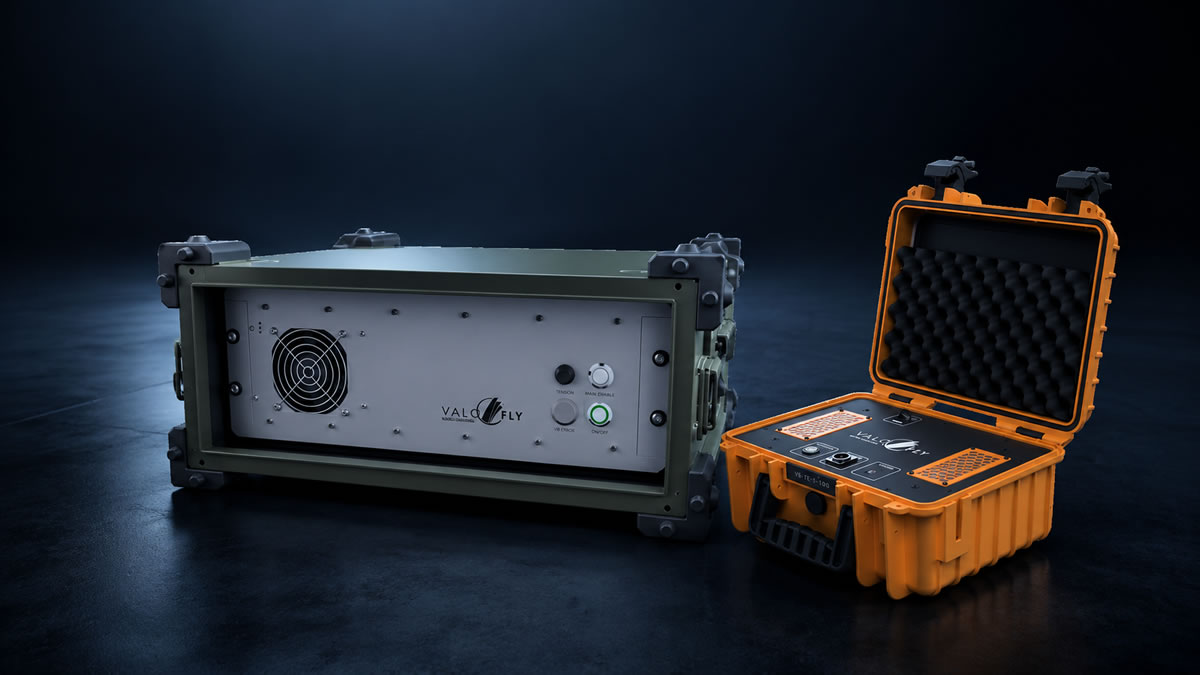
VALOFLY microTether for Compact UAV Integration
VALOFLY TGS microTether combines a compact ground power unit with a tether cable supplied as a cable loop or on a reel. Vectorbirds integrates the solution to suit the UAV, payload and mission profile.
Our planned Valofly integrations use cable lengths of up to approximately 100 m. Usable flight altitude depends on cable weight, cable geometry, wind, payload and UAV power reserves; cable length and flight altitude are not interchangeable.
According to VALOFLY, TGS microTether offers up to 1.4 kW output power and optional singlemode fibre up to 1 Gbit/s per fibre, depending on configuration. Usable power at the UAV, supply requirements, system throughput, cable configuration and the matching Tether Vehicle Module are specified together. The choice between microTether and rackTether depends on installation space, cable management and mission requirements.
System overview | Tether operating mode
Tether Operation for Power, Data and Controlled UAV Presence
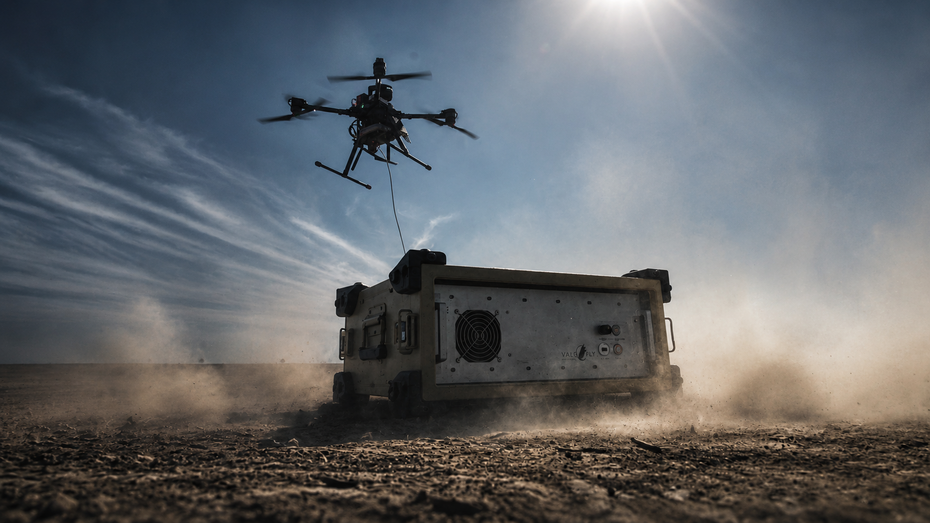
In tether operation, a suitable UAV is connected to a ground unit via a tether cable. Depending on the system design, the cable supplies the flight platform with electrical power and can also provide data paths for control, telemetry, mission data, payload data, video or network access.
The key advantage of this tether-supported operating mode is extended endurance, stable system connectivity and controlled UAV presence at a defined position. While a free-flying UAV is limited by battery capacity, radio data link range and mission duration, a tether system enables stationary or semi-stationary operation over significantly longer periods of time.
Typical mission profiles include stationary situational awareness, perimeter monitoring, temporary communication nodes, relay applications, security observation and mission-specific operating modes where an elevated sensor or antenna position is required for an extended period.
Technology partner | VALOFLY tether systems
VALOFLY Tether Technology in Vectorbirds UAV Systems
Vectorbirds integrates VALOFLY tether technology into suitable Vectorbirds UAV systems and adapts it to platform, payload, operating altitude, data connectivity and mission profile. The tether hardware is developed and manufactured by the German manufacturer VALOFLY; Vectorbirds handles UAV-side integration, platform adaptation, payload integration and mission-specific configuration of the overall system.
Over the past years, Vectorbirds has carried out extensive development, optimisation and adaptation work to reliably connect tether systems with its own UAV platforms. This includes mechanical and electrical integration, power supply coordination, integration of the Tether Vehicle Module, system parameterisation and adaptation to payload, operating altitude, communication architecture and safety requirements.
The result is not a simple accessory solution, but an integrated cable-based UAV operating mode for Vectorbirds UAV systems. Depending on the mission profile, different power levels, cable lengths, data options, network functions and UAV configurations can be combined.
Tether ground units | Power, cable management & data options
Tether Ground Units for Power, Network and Higher Operating Altitudes
Vectorbirds integrates VALOFLY tether ground units into suitable UAV systems. Ground station, cable, Tether Vehicle Module, aircraft and payload are engineered as a matched configuration.
VALOFLY currently lists the rackTether and microTether ground stations. rackTether uses two 19-inch cassettes for electronics and cable management and can also be integrated into vehicle and platform solutions.
The power class up to 2.5 kW and cable lengths up to approximately 100 m form the basis for the intended applications. VALOFLY specifies a configuration-dependent output of up to 2.5 kW for rackTether. Power available at the UAV at the selected cable length is assessed together with cable, onboard module, payload and operating conditions; this is not a blanket power guarantee for every aircraft.
According to the manufacturer, rackTether supports singlemode fibre with up to 1 Gbit/s per fibre. Usable data throughput is specified for the complete link. A separate fibre-optic or network connection to a remote control position is a distinct part of the system architecture.
Performance ranges | Tether configurations
Tether Configurations from Micro-Tether to Ground Unit
Vectorbirds combines the VALOFLY ground station, tether cable, Tether Vehicle Module, UAV and payload for each project. Up to 2.5 kW and cable lengths up to approximately 100 m form the basis for the intended applications; the selected configuration determines usable power and operating altitude.
| Configuration | Typical application | Power | Cable length | Data options |
|---|---|---|---|---|
| VALOFLY TGS microTether | Compact integration; cable supplied as a loop or on a reel | Up to 1.4 kW according to the manufacturer, configuration-dependent; power available at the UAV specified separately | Up to approximately 100 m within the intended integration scope; usable flight altitude specified separately | Singlemode fibre up to 1 Gbit/s per fibre according to the manufacturer; system throughput depends on configuration |
| VALOFLY TGS rackTether | Modular ground station with electronics and tether cassettes; platform and vehicle integration | Up to 2.5 kW, configuration-dependent; power available at the UAV specified separately | Up to approximately 100 m within the intended integration scope; usable flight altitude specified separately | Singlemode fibre up to 1 Gbit/s per fibre according to the manufacturer; system throughput depends on configuration |
Cable length is not a guaranteed flight altitude. UAV, take-off mass, payload, wind, cable geometry, electrical and thermal reserves and safety functions determine operating limits. Ground station, cable and onboard module are selected together and assessed for the intended application.
Manufacturer information, as of 12 October 2026: VALOFLY TGS microTether and TGS rackTether. Ground-station output power must be distinguished from usable power at the UAV.
UAV integration | Tether Vehicle Module
TVM as UAV Interface for Tether Power and Onboard Architecture
The Tether Vehicle Module, or TVM, forms the UAV-side interface between tether cable, power supply and onboard architecture. It replaces the previously used term OBM or onboard module and describes the electronic unit integrated on the UAV.
Depending on the system design, the TVM handles the connection of the tether power supply, voltage adaptation, integration into the onboard power system and coordination with buffer battery, flight controller, payload and safety functions. This makes the TVM a central component of tether integration and not merely an external accessory.
Vectorbirds configures the TVM according to the respective UAV platform, payload and tether configuration. Key factors include power demand, take-off weight, cable length, thermal management, electrical protection functions and the desired operating profile. Only through this UAV-side integration does a tether ground unit become a robust cable-based UAV system solution.
Operational safety | Buffer energy & protection functions
Operational Safety with Buffer Battery and Protection Functions
In tether integrations, operational safety plays a central role. For this reason, the UAV can be equipped with a buffer battery in addition to the cable-based power supply. This stabilises onboard voltage, supports the system during load changes and increases the operational safety reserve.
The buffer battery can compensate for voltage fluctuations, short-term load peaks or disturbances in the ground-side power supply and thereby relieves the Tether Vehicle Module as well as the UAV-side onboard electronics. It is particularly relevant when payload, flight controller, data link and other consumers must be supplied reliably.
Protection functions and safety logic are configured by Vectorbirds according to UAV platform, tether configuration, operating altitude, payload and mission profile. In the event of an interruption in tether power supply, the UAV can, depending on the system design, continue operating in a controlled manner, transition into a defined safety state or land safely.
Data connection | Network, video & fibre optics
Data and Network Access via Tether or Hybrid Architecture
Tether systems can provide not only cable-based power supply, but also data access, network access and mission communication via tether or via a hybrid architecture. This allows the UAV to be integrated into a controlled cable-based or hybrid communication architecture.
In simple configurations, the UAV is powered via the tether cable, while control, telemetry and payload data continue to be transmitted via radio. In extended configurations, Ethernet, network access, video data or mission-specific data paths can additionally be routed via the tether connection.
For more demanding applications, fibre-optic options are also possible depending on the tether system and integration setup. These are particularly suitable for mission profiles with increased requirements for data stability, range of the ground-side connection, network segmentation, video streaming or integration into higher-level control and mission systems.
As part of the system integration process, Vectorbirds evaluates whether a radio/tether hybrid architecture, a cable-based data solution or a separated power and data architecture is appropriate. Key factors include operating altitude, data volume, latency requirements, security level, payload and the existing infrastructure at the deployment site.
Operating modes | Battery, hybrid & cable-based operation
UAV Operating Modes for Battery, Hybrid and Cable-Based Operation
Different UAV operating modes can be configured for tether systems – from battery operation through hybrid operation to cable-based power and data operation. The decisive factor is whether the UAV should operate completely free-flying, be supplied with power via the tether cable or additionally be integrated into the data and network architecture via the cable.
| Operating mode | Power supply | Data / control | Typical operational benefit |
|---|---|---|---|
| Battery operation | Onboard battery | Radio datalink | Maximum mobility and free UAV operation without cable connection |
| Hybrid tether operation | Tether cable, optionally with buffer battery | Control, telemetry and payload data continue to be transmitted via radio | Extended endurance while maintaining separate radio communication |
| Cable-based power and data operation | Tether cable, optionally with buffer battery | Data, network or video path possible via tether depending on configuration | Controlled stationary operating architecture with stable cable-based connection |
| Redundant radio/cable architecture | Tether cable and onboard battery as safety reserve | Combination of radio datalink and cable-based data option | Increased operational safety and flexible communication architecture for demanding mission profiles |
Vectorbirds defines the appropriate operating mode based on UAV platform, payload, operating altitude, data demand, ground-side power supply, safety requirements and the desired mission duration.
UAV integration | Platform, payload & mission profile
Tether Integration by Platform, Payload and Mission Profile
Tether integration at Vectorbirds is configured according to platform, payload and mission profile. Key factors include UAV platform, operating altitude, power demand, data connectivity, safety logic and the intended operating environment.
Depending on the platform, tether integration can be implemented for compact reconnaissance UAVs, larger multirotor systems or mission-specific payload carriers. Tether ground unit, tether cable, Tether Vehicle Module, buffer battery, flight controller, payload, data link and Ground Control Station are considered as one integrated system.
For smaller UAVs, Micro-Tether integration may be suitable when a compact power supply for reduced operating altitudes is the main requirement. For larger platforms, higher power demand, longer cable lengths or extended data and network functions, more powerful tether ground units are used.
Vectorbirds evaluates, among other factors, take-off weight, lifting capability, wind load, cable length, electrical power reserve, payload data, safety logic and the intended operating environment. The result is not an isolated accessory system, but a cable-based operating mode adapted to the respective UAV.
System distinction | TETHER & TELEVATOR
Tether Operation as Technical Level, TELEVATOR as Mobile Platform Integration
Tether operation and TELEVATOR describe different levels of a cable-based UAV solution. Tether operation covers the technical level with tether ground unit, tether cable, Tether Vehicle Module, power supply and optional data connection. TELEVATOR, by contrast, describes a more comprehensive mobile platform and vehicle integration.
A tether system can generally be operated stationary on the ground, deployed remotely in the field or used in combination with a suitable platform. Depending on the system concept, the UAV launches from the ground, from a defined deployment position or from a mobile carrier surface.
TELEVATOR extends this approach into an integrated mobile operating environment. UAV, tether system, landing station, power supply and operator architecture are combined on a suitable vehicle or carrier platform. This allows the system to be prepared, relocated, operated and landed again without having to set up the tether system separately in the field.
For purely stationary or semi-stationary applications, classic tether operation is often sufficient. If mobile deployment, vehicle integration, automated launch and landing operation or a tactically relocatable overall system are required, TELEVATOR is the appropriate system level.
Mission profiles | Observation, communication & situational awareness
Tether Mission Profiles for Observation, Communication and Situational Awareness
Tether mission profiles are relevant wherever observation, communication or situational awareness needs to be supported from a defined elevated position over an extended period of time. The combination of cable-based power supply, stable system connection and an elevated sensor or antenna position creates operational value compared to purely battery-based short-duration flights.
- Persistent situational awareness: continuous observation from an elevated position for command staff, security forces or technical monitoring applications.
- Perimeter and asset protection: extended monitoring of access points, terrain sections, infrastructure, events or temporary security areas.
- Temporary communication node: use of the UAV as an elevated antenna, relay, router or repeater position to extend local communication ranges.
- Stationary ISR applications: aerial observation with EO/IR sensors for reconnaissance, surveillance and security-critical situational assessment.
- Technical inspection and infrastructure monitoring: controlled observation of facilities, transport routes, construction sites, energy infrastructure or hard-to-access areas.
- Mobile or remote deployment: operation of a tether system directly at the deployment site, remotely in the field or as part of a larger mobile system architecture.
The specific suitability depends on UAV platform, payload, desired operating altitude, data connectivity, ground-side power supply and the respective safety concept. Vectorbirds evaluates these factors and derives a suitable tether configuration from them.
Project Request | Tether Integration
Assess your tether use case with Vectorbirds
Are you planning a UAV mission with extended endurance, cable-based power supply, stable data connectivity or a stationary observation and communication solution? As part of the project request, Vectorbirds supports the assessment, configuration and integration of suitable tether configurations.
Together, we clarify UAV platform, payload, operating altitude, power demand, data requirements, operating mode and the appropriate tether integration of tether ground unit, tether cable, Tether Vehicle Module, buffer battery and Ground Control Station.