Relay UAV | Communications Relay, MANET & IP Data Link
Relay UAV for communications support and mobile networks
Vectorbirds develops and integrates relay UAV systems for communications support, elevated relay positions, MANET/mesh networks, IP data links, mobile mission architectures and project-specific UAV system integration.

A relay UAV extends communications and data-link structures by acting as an elevated network node or temporary relay position. This can help connect mobile units, vehicles, sensors, UAV systems or remote forces within suitable mission architectures.
Vectorbirds combines its own UAV platforms, mesh-capable data links, IP-based system architecture, relay hardware, ground-control components, tether options and customer-specific payload integration into relay UAV systems that can be configured for operational use.
The focus is not on isolated radio modules, but on complete UAV systems in which flight platform, relay payload, antenna concept, power supply, data path, operator logic, tether option and system connectivity are aligned with the respective mission profile.
View VECTIS Relay M2 Request relay project

Basic Principle | Elevated Network Node from the Air
What is a relay UAV?
A relay UAV is an unmanned aerial vehicle used as an airborne communications node. It can support data links, radio connections, IP networks or mesh-capable communications systems by taking an elevated position above terrain, vehicles or mission forces.
Its value comes from altitude and flexible positioning. In many operational environments, elevated relay positions improve line of sight between communications partners, reduce shadowing by terrain or buildings and enable temporary data paths without permanent mast or tower infrastructure.
Elevated relay position
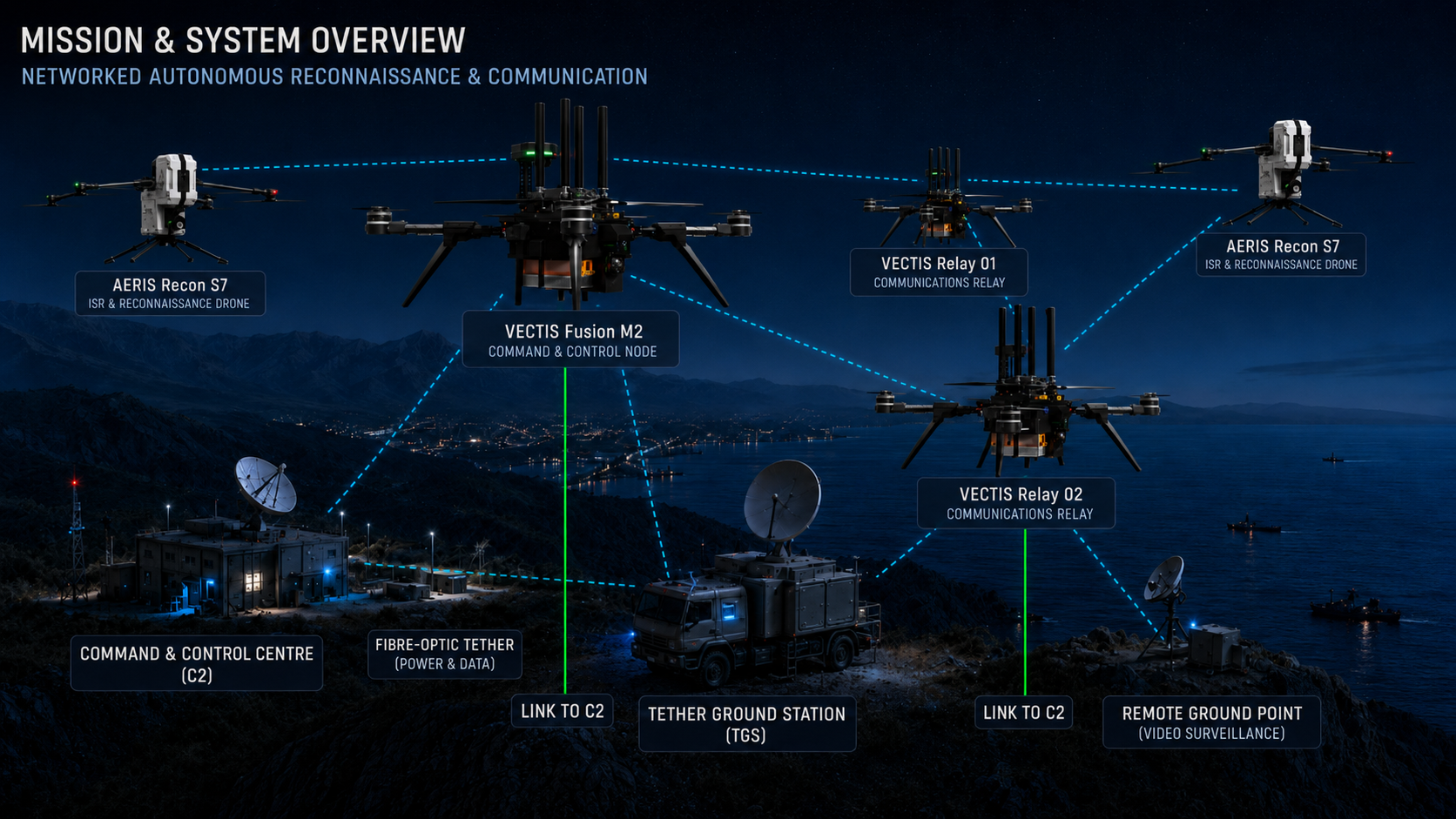
The UAV acts as a temporary node in the air and can support communications paths between mobile units, vehicles, sensors or additional UAV systems.
Data-link extension
Relay UAVs can extend data links through suitable radio modules, antennas, IP components or network devices. The actual range depends on system, antennas, altitude and environment.
Temporary network node
A relay UAV can be used as a temporary part of a mobile communications architecture, for example for mission vehicles, remote forces or mobile command posts.
For professional applications, a relay UAV is therefore not just a radio extender, but a communications-capable UAV system consisting of flight platform, relay payload, antenna concept, power supply, data path and operator logic.
Mission Profiles | Communications, Situational Awareness & Mobile Units
Mission profiles for relay UAVs
Relay UAVs are particularly relevant when communications need to be supported in mobile, temporary or difficult-to-cover mission areas. The UAV can act as an elevated node between vehicles, UAVs, sensors, operators, command posts or remote forces.
Mobile mission forces
Relay UAVs can support communications paths between mobile forces, vehicles and mission command when direct links are limited or unstable.
Vehicle-related communications
On or near mobile platforms, a relay UAV can provide elevated data links and improve connectivity between vehicle, operator and further system components.
UAV-to-UAV connectivity
In suitable architectures, a relay UAV can connect other UAV systems, payload data or video streams into a wider network.
Temporary network coverage
During exercises, missions, events or temporary protection tasks, an airborne relay point can help extend local communications coverage on a project-specific basis.
Remote sensor integration
Sensors, cameras or mobile observation points can be connected to an IP-based mission architecture through relay components.
Tactical communications support
For defence-related and public-sector applications, a relay UAV can be assessed as a temporary relay position within a tactical communications architecture.
The specific configuration depends on data rate, radio technology, antenna concept, mission altitude, power demand, payload, flight time, tether option and system environment.
Data-Link Architecture | IP, MANET & Mesh Communications
Communications architecture, MANET and mesh
Relay UAVs deliver value only when combined with the right communications architecture. The key factors are not just radio range or transmit power, but the interaction of data link, antenna concept, IP network, routing, payload data, video streams, telemetry and ground-control components.
Vectorbirds configures relay UAV systems so they can be integrated into existing or project-specific network architectures. Depending on requirements, mesh-capable data links, MANET components, IP-based interfaces, local network nodes, payload integration and customer-specific operator interfaces may be used.
IP-based architecture
Video, telemetry, payload data, network access and ground-control components can be connected through IP-based structures and routed on a project-specific basis.
MANET components
Mobile ad-hoc networks can support communications paths dynamically. Suitability depends on radio module, network topology, data rate and mission environment.
Mesh-capable data links
Mesh-capable data links can connect multiple participants and make relay UAVs usable as elevated nodes within temporary network structures.
For robust relay architectures, radio technology, antenna position, data rate, latency, encryption, system load, power demand and mechanical integration must be assessed together.
Operating Modes | Battery, Tether & Stationary Relay Position
Relay UAV in tethered or battery-powered operation
A relay UAV can be operated in battery-powered mode or as a tether-supported UAV system depending on platform and mission profile. Battery-powered operation is suitable for flexible, time-limited relay missions. Tethered operation is particularly relevant when an elevated relay position needs to remain available at a defined location for an extended period.
In tethered operation, the UAV is supplied with power through a cable and, depending on the system architecture, can also use cable-based data or fibre-optic connectivity. This turns the relay UAV into a stationary or semi-stationary communications node.
Battery-powered operation
Suitable for mobile, short-term or flexible relay missions where repositioning, free flight movement and rapid availability are more important than maximum mission duration.
Tethered operation
Suitable for stationary or semi-stationary communications support, extended UAV presence, defined relay positions and mobile platform integration.
The overview page for tethered UAV systems for stationary missions explains the technical system logic of cable-connected UAV applications in detail. For specific relay applications, Vectorbirds assesses whether battery operation, TETHER, TELEVATOR or a combined architecture is technically suitable.
Vectorbirds Platform | VECTIS Relay M2
VECTIS Relay M2 as tactical relay UAV
The VECTIS Relay M2 is the Vectorbirds platform for tactical relay and communications support in the M2 class. It is designed for elevated relay positions, data-link extension, IP-based system connectivity, MANET/mesh communications and project-specific payload integration.
Depending on the project, VECTIS Relay M2 can be combined with different data-link, antenna, relay and tether components. The platform is therefore not an isolated radio device, but part of a complete communications and UAV system architecture.
M2 class
The VECTIS platform in the M2 class provides a suitable size and payload basis for professional relay configurations.
Relay payloads
Radio modules, antennas, network components or customer-specific payloads can be integrated mechanically and electrically on a project-specific basis.
Tether option
For stationary or semi-stationary relay profiles, VECTIS Relay M2 can be combined with TETHER or TELEVATOR and assessed technically.
The specific configuration depends on communications objective, data rate, payload weight, mission altitude, wind, power demand, tether option, centre of gravity and integration environment.
Technical Configuration | Data Rate, Antennas, Power & Integration
Technical requirements for relay UAVs
A relay UAV must be configured as a complete technical system. In addition to the flight platform, radio technology, antenna concept, IP architecture, data rate, latency, power demand, payload weight, centre of gravity, thermal reserves, operator logic and safety concept are decisive.
Data rate and latency
Video streams, telemetry, payload data and network access place different demands on bandwidth, stability and delay.
Antenna concept
Antenna position, radiation pattern, mechanical installation and shadowing by UAV structure or payload significantly influence relay performance.
Power demand
Relay hardware, network components, cameras or compute units increase power demand and must be considered in battery-powered or tethered operation.
Mechanical integration
Radio modules, antennas, brackets, cable routing and protective housings must be integrated while maintaining flight behaviour, centre of gravity and maintainability.
System connectivity
Ground control, payload control, network access, video streams and customer interfaces must be brought together logically and technically.
Operating limits
Wind, mission altitude, payload, flight time, temperature, tether angle and data-link environment together determine the technically reliable operating range.
Vectorbirds therefore assesses relay configurations not only by individual components, but by the interaction between UAV platform, communications payload and mission architecture.
Operating Characteristics | Value, Range & System Limits
Advantages and limitations of UAV relay systems
UAV relay systems can significantly support communications in temporary or mobile mission areas. However, they do not replace careful radio and network planning. Range, data rate and stability always depend on frequency, radio module, antennas, altitude, terrain, interference, payload and operating mode.
Flexible relay position
The relay position can be moved into the air depending on the mission without building fixed infrastructure.
Improved line of sight
The elevated position can reduce radio shadowing and improve communications paths between participants.
Temporary network extension
Relay UAVs can be used for time-limited tasks without permanent mast, tower or infrastructure measures.
Environment-dependent performance
Terrain, buildings, vegetation, interference, antenna alignment and frequency band strongly influence performance.
Payload and power reserves
Relay hardware increases weight, power demand and heat generation. These factors must be considered in flight time, tether configuration and safety reserves.
No generic promise
Relay range and data rate cannot be stated reliably without a specific configuration. Robust statements require system and mission assessment.
This is why Vectorbirds configures relay UAV systems on a project-specific basis and assesses communications objective, environment, payload, platform, data link and operating mode together.
FAQ | Relay UAV, MANET & Communications Relay
Frequently asked questions about relay UAVs
What is a relay UAV?
A relay UAV is an unmanned aerial vehicle that supports communications and data-link connections as an elevated relay position or airborne network node.
What is a relay UAV used for?
Typical applications include communications support, data-link extension, MANET/mesh networks, mobile command architectures, vehicle connectivity and temporary network coverage.
Does a relay UAV automatically increase range?
It can improve communications paths, but range and data rate depend on radio technology, antennas, altitude, terrain, interference, data load and system architecture.
Can a relay UAV be used in tethered operation?
Yes. For stationary or semi-stationary relay profiles, tethered operation can be useful when an elevated relay position needs to remain available at a defined location for an extended period.
What does MANET mean for relay UAVs?
MANET stands for mobile ad-hoc network, in which participants can communicate dynamically with each other. A UAV can be used as an elevated node within such a network.
What role does the antenna play?
Antenna position, orientation, radiation pattern and shadowing have a major influence on data rate, range and stability of the relay system.
Is VECTIS Relay M2 a relay UAV?
Yes. VECTIS Relay M2 is designed as a tactical relay UAV for communications support, elevated relay positions and project-specific data-link integration.
When is project assessment required?
Whenever range, data rate, payload, tether option, platform integration or connection to existing communications systems must be assessed reliably.
Project Request | Relay UAV & Communications Architecture
Discuss your relay UAV project with Vectorbirds
Are you planning a relay UAV for communications support, MANET/mesh networks, IP data links, mobile platforms, tethered operation or tactical mission architectures? Vectorbirds supports technical assessment, UAV selection, relay payload integration, antenna concept, power supply, data path and system connectivity.
Describe your communications objective, mission environment, required data rate, participant structure, payload, platform environment, tether requirement and existing system architecture. We assess which UAV platform and relay configuration makes technical sense.