UAV Systems | VECTIS R
VECTIS R – coaxial octocopter platform for heavy payloads
VECTIS R extends the VECTIS M2 system architecture with a coaxial octocopter configuration for heavy sensor, relay and mission payloads.
VECTIS R is designed as a heavy-payload UAV for applications that require the integration of larger sensors, relay hardware or customer-specific mission components. The platform is based on the VECTIS / Kite 75 architecture and uses four arms, each with one upper and one lower motor.
This coaxial octocopter platform increases propulsion redundancy and provides additional payload margin for demanding EO/IR, radio, datalink and mission configurations. Depending on the mission profile, larger camera payloads, communication hardware, mission computers, datalink components or customer-specific payloads can be integrated.
Tether operation is possible depending on the configuration. Due to the lower propellers as well as the different landing gear and landing geometry, VECTIS R is not intended as a standard configuration for the existing TELEVATOR / landering architecture.
System Variants | Recon & Relay
VECTIS R configurations
VECTIS R is configured for mission-specific payloads. The system architecture can be adapted for heavy sensors, tactical communication relay payloads or customer-specific mission hardware.
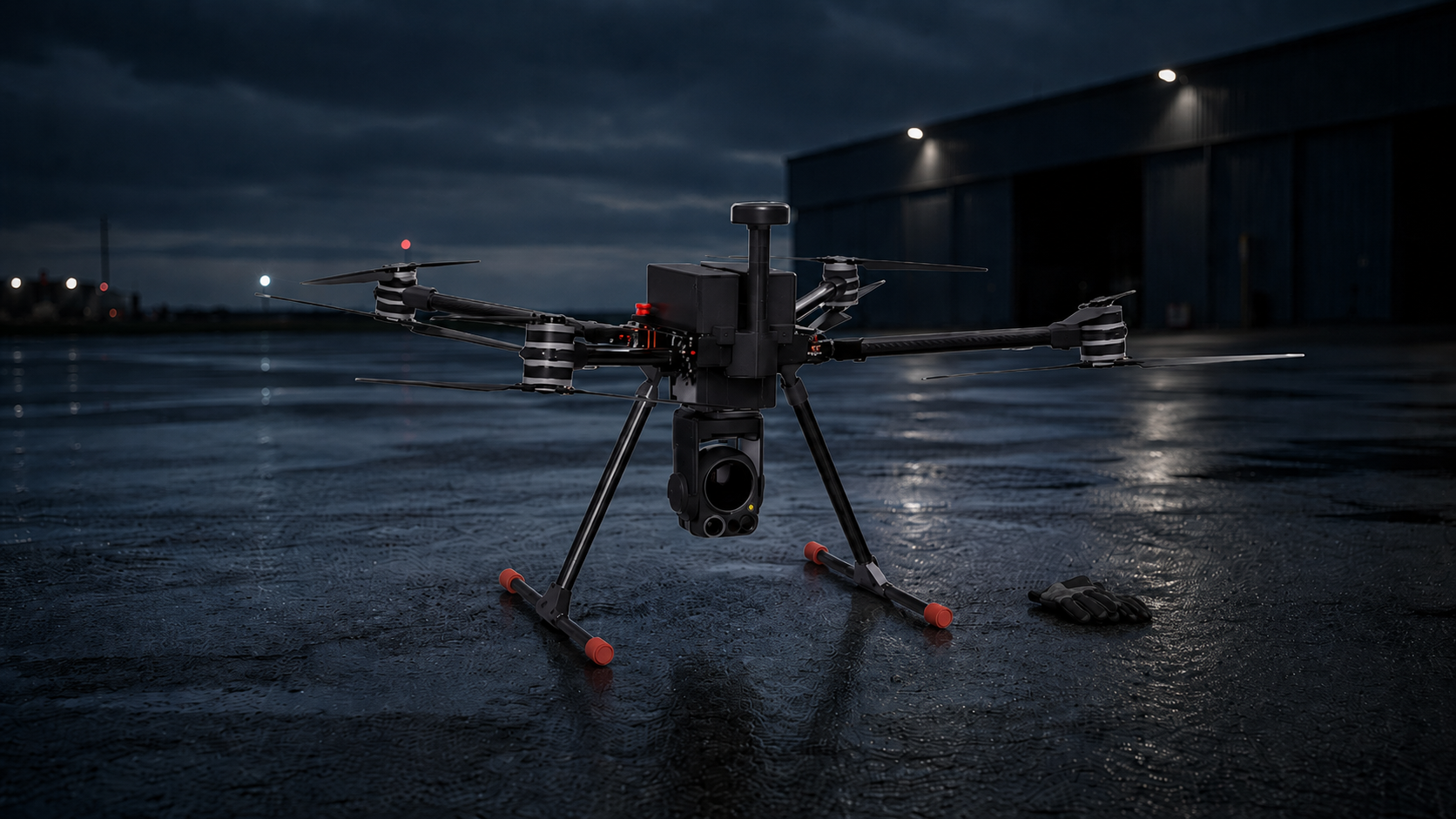
Recon configuration
VECTIS R Recon M2
VECTIS R Recon M2 is designed as a reconnaissance UAV with high payload margin for underside-mounted EO/IR and EO/IR/MWIR payloads. The retractable landing gear supports a largely unobstructed field of view for the camera payload and is particularly suited for tactical ISR, observation and reconnaissance missions.
Sensor payload, mission computer, data link and power supply are engineered together. Payload limits and sensor specifications of the specific configuration are available on request.
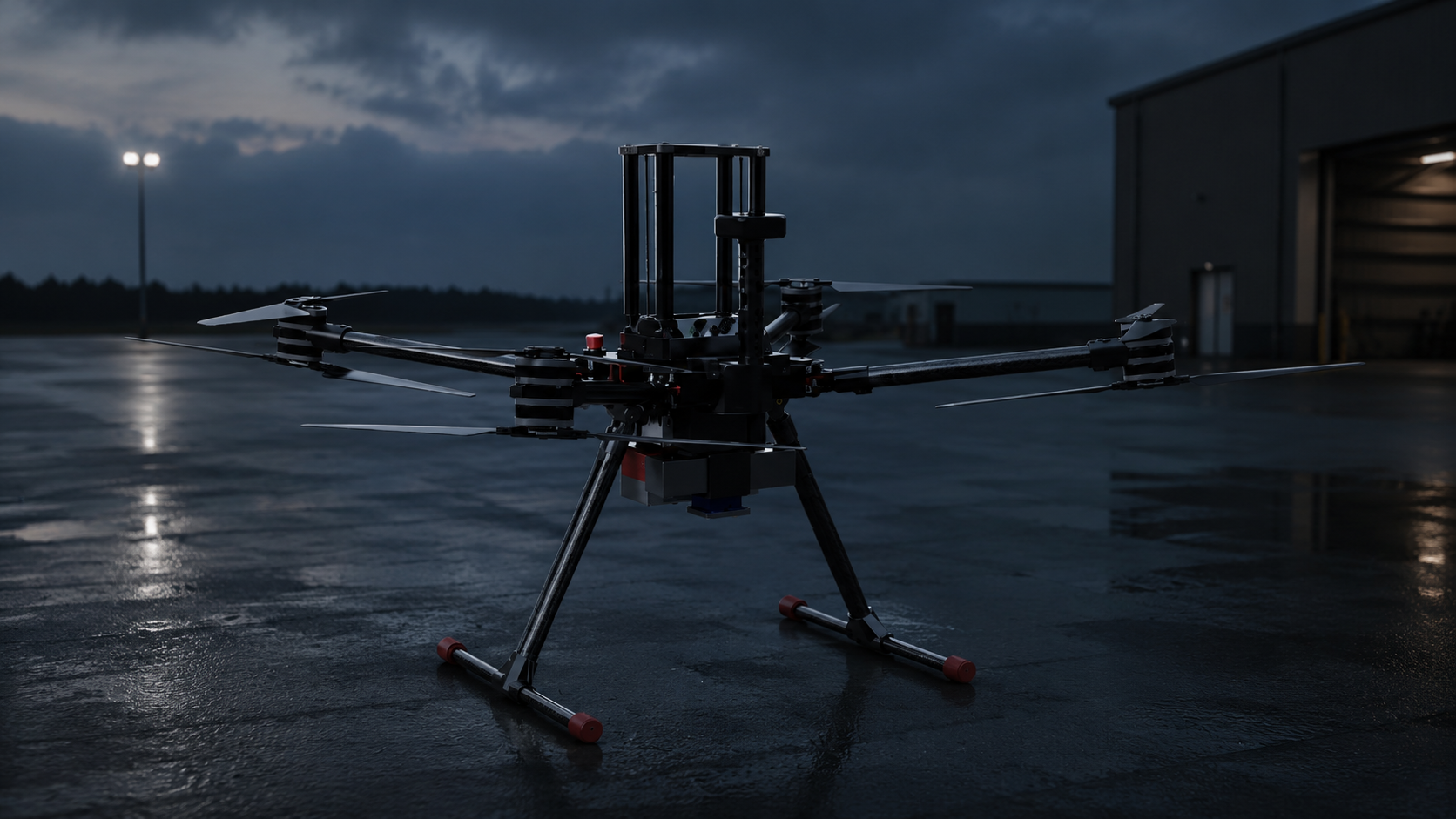
Relay configuration
VECTIS R Relay M2
VECTIS R Relay M2 is designed as a relay UAV for radio and datalink hardware with increased payload margin. The coaxial octocopter configuration provides additional reserves for communication modules, antennas, mission computers and project-specific system components.
Optionally, a compact detachable EO/IR situational-awareness camera with quick release can be added. The primary purpose, however, remains operation as a UAV communication relay and tactical datalink platform.
System Logistics | Transport & Handling
Transport, folding mechanism and compact stowage
VECTIS R is designed as a compact transport UAV for mobile and vehicle-based mission profiles. Its folding arm geometry enables space-saving stowage, allowing the UAV to be folded down into a significantly more compact form for storage, vehicle transport and mission preparation.
Transport and system height depend on landing gear, antennas, propeller position, payload mounting and payload. Dimensions of the specific configuration are available on request.
Especially in Recon configurations, the underside-mounted payload is a key factor for ground clearance, landing gear design and system height during operation. The landing gear can be extended if required to accommodate larger EO/IR or EO/IR/MWIR payloads and to provide suitable clearance for the sensor system.
VECTIS R therefore combines high payload margin with compact transport geometry. The benefit is not limited to reduced dimensions, but also includes easier loading and unloading, temporary storage and mission preparation.
Technical classification | VECTIS R
Architecture and configuration-dependent specifications
VECTIS R uses four arms with eight coaxial propulsion units. The Recon variant prioritises EO/IR sensors; the Relay variant prioritises communications payloads. Additional sensor, communications and mission modules are integrated within available system margins. Dimensions, empty mass, MTOW, propellers, payload and endurance are defined for the specific configuration; details on request.
| Platform | Four arms, eight coaxial propulsion units |
|---|---|
| Mission role | Recon: EO/IR sensors; Relay: communications and antennas |
| Geometry and transport dimensions | Dependent on payload, landing gear and configuration; on request |
| Empty mass, MTOW and payload | On request for the specific configuration |
| Propulsion, propellers and endurance | On request for the specific power and mission profile |
| Mission processing | Optional onboard processing, IP streaming, recording and container functions; configuration-dependent |
Payloads | Sensors & Mission Data
Payloads, sensors and mission computer
VECTIS R is intended for mission configurations that require additional payload margin for sensors, radio systems or onboard data processing. Depending on the mission profile, the platform can be configured for reconnaissance, relay or customer-specific payloads.
Recon payloads
Underside-mounted EO/IR or additional sensor payloads are selected for each reconnaissance and ISR project. Payload mass, optical and digital zoom and native detector resolutions are specified separately for the selected configuration; values on request.
The retractable landing gear is particularly relevant for recon configurations because it provides a largely unobstructed field of view for the underside-mounted camera payload. For larger payloads, landing gear height, ground clearance and center-of-gravity position can be adapted to the project.
Relay and datalink payloads
For relay applications, VECTIS R can be configured with radio, datalink, antenna and network components. Particularly relevant are MANET/mesh datalinks, tactical IP radio networks, antenna geometry, buffer battery, mounts, cabling and integration into existing communication or C2 structures.
Optionally, a compact detachable EO/IR situational-awareness camera with quick release can be added. The primary purpose of a relay configuration, however, remains radio, datalink and network operation.
Mission computer and data processing
For suitable system configurations, a mission computer configuration with project-specific storage, video processing, IP streaming, recording and Docker/container capability can be integrated. This allows video, sensor and mission data to be processed locally, recorded and connected to IP-based system architectures.
Tether operation
Tether integration and TELEVATOR compatibility
Tether operation is engineered as a complete system comprising the ground station, cable, vehicle module, buffer power, UAV and payload. Usable altitude, onboard power and payload must be defined together, including wind and operating margins. The standard TELEVATOR landing ring is not compatible with VECTIS R. Configuration and performance data on request.
VECTIS R Recon – datasheet
October 2026
VECTIS R Relay – datasheet
October 2026
Project Request | VECTIS R
Configure VECTIS R for heavy payloads
VECTIS R is intended for projects that require the integration of larger sensors, relay hardware, mission computers, antennas, datalink components or customer-specific payloads. The final configuration depends on payload, center of gravity, power demand, flight time, tether option and required system integration.
For a robust configuration, we evaluate recon, relay or special payloads, battery and power setup, landing gear, transport geometry, datalink, mission computer, ground system and mission profile together with the project requirements.